Impact at a Glance
The Challenge
Maryland's Department of Health operates web applications serving a highly diverse public, including elderly users, users with disabilities, and non-English speakers. Applications lacked a consistent design language, had significant accessibility gaps, and were not optimised for mobile or tablet access.
"Healthcare platforms carry a higher accessibility obligation than most, failing a user who needs to access medical information is not an acceptable outcome."
- No consistent design system across MDH applications
- Accessibility failures putting the agency at compliance risk
- No mobile-first architecture, key public health tools unusable on phones
- Design-to-development handoff inconsistencies causing UI bugs in production
UX Architecture
Defined a scalable UI system aligned to component-based architecture, from design tokens through to responsive layout patterns and accessibility standards.
My Role
Design System
Built and maintained scalable UI components supporting reusable patterns across all MDH applications.
Mobile-First Architecture
Established responsive layouts, CSS utility approach ensuring consistency from mobile to large desktop.
Accessibility Audits
WCAG 2.1 AA audits using JAWS, NVDA, Axe, AInspector, WAVE. Iterative remediation with dev teams.
Developer Collaboration
Translated UX into modular UI using HTML5, CSS3, JavaScript, and Tailwind CSS conventions.
User Research
Qualitative feedback synthesis from diverse healthcare user groups, informing design improvements continuously.
Team Mentorship
Knowledge sharing on design systems, accessibility, and UX tools with cross-functional team members.
Design Process
Audit
Full accessibility and design consistency audit across existing MDH applications
System
Built component library, mobile-first, WCAG-compliant, Tailwind-aligned
Test
Multi-device usability testing: desktop, tablet, mobile with diverse user groups
Iterate
Continuous improvement loop, research findings → design updates → developer handoff
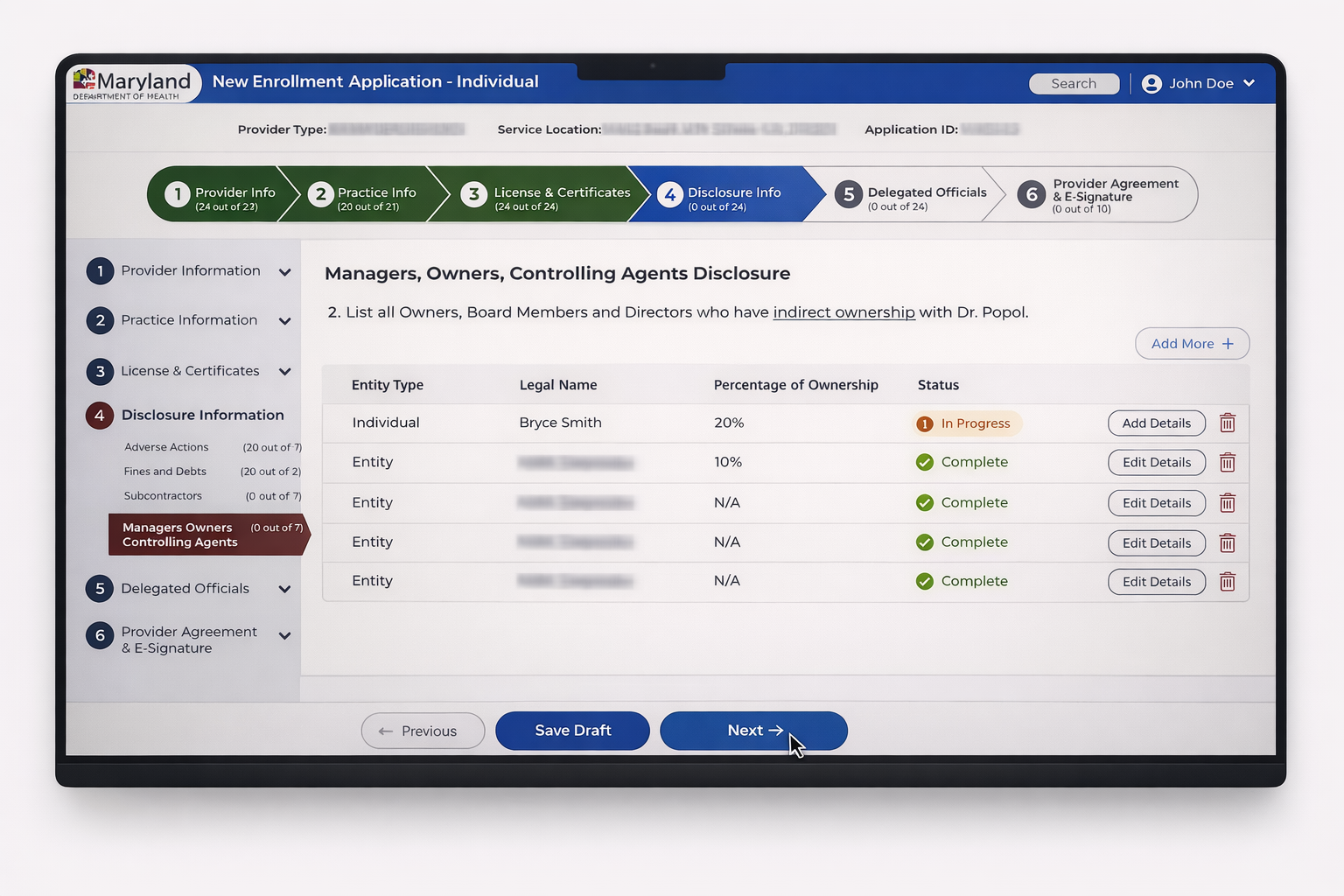
Production screens are protected under a state government confidentiality agreement. Architecture diagrams represent the UX system approach.